
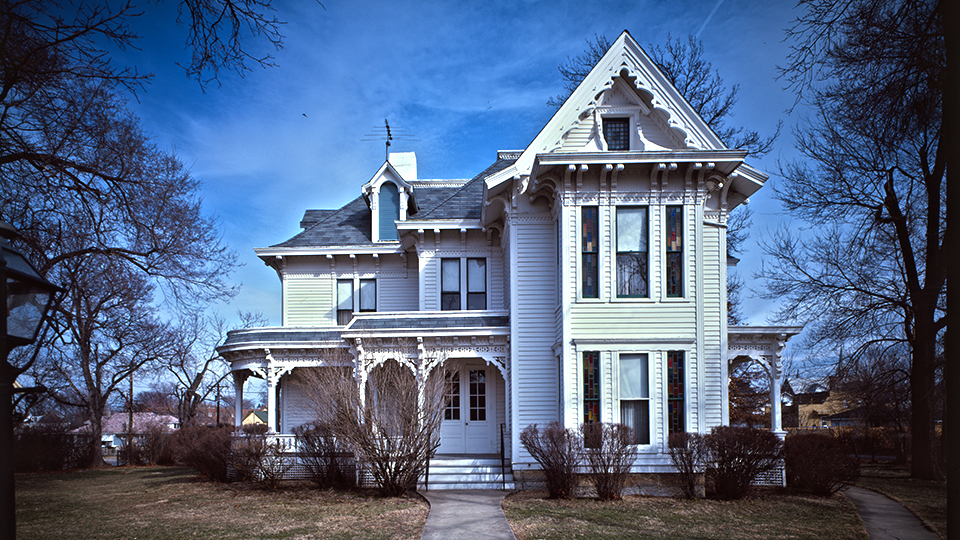
The Harry S Truman National Historic Site [†] is nationally significant as the home of Harry S Truman, the 33rd President of the United States. Located at 219 North Delaware Street in Independence, Missouri, this residence served as Truman's home from his marriage to Elizabeth Virginia "Bess" Wallace on June 28, 1919, until his death on December 26, 1972. The property became known as the "Summer White House" during Truman's presidency and drew national and international attention throughout his political career.
Property Details
The property occupies city Lots 2 and 3 of James F. Moore's Addition in Independence, measuring 175 by 225 feet (0.77 acres). It is located in Missouri's 5th Congressional District in Jackson County. The site was designated a National Historic Landmark on February 23, 1972, and formally became the Harry S Truman National Historic Site when Secretary of the Interior James G. Watt signed Designation Order No. 3088 on December 8, 1982, following Bess Truman's bequest of the residence to the Federal Government. Congressional authorization followed with President Ronald Reagan signing P.L. 98-32 on May 23, 1983.
Construction History
The house has a complex three-phase construction history. George Porterfield Gates, Bess Truman's grandfather, purchased Lots 2 and 3 on June 20, 1867, for $700. While family tradition suggests Gates built the original home, archival and structural investigations indicate an earlier structure existed. The second addition came in 1867 to accommodate the expanding Gates family, which included three daughters (Margaret "Madge," Maud, and Myra) and later two sons (G. Walter and Frank E.). Evidence of fire damage from charred roof rafters suggests the configuration changed during these post-Civil War years.
In 1885, George P. Gates commissioned Independence's most noted builder and architect, James W. Adams, to construct a significant expansion. This project created a 2.5-story facade fronting North Delaware Street and enveloped the west and south portions of the 1867 structure with a unifying architectural style. The ambitious project featured fourteen rooms, water and gas systems, and was the most expensive Independence residence built in 1885 at $8,000. Finishing touches including fancy porches, windows, doors, mantels, lights, and a slate roof were completed by mid-1886. Gates, a partner in the Waggoner-Gates Milling Company (manufacturers of Queen of the Pantry Flour), wanted a house reflecting his prominent standing in the community and serving as a comfortable retirement home.
The Wallace Family
Gates's oldest daughter, Madge, married David Willock Wallace on June 13, 1883, with the ceremony at the First Presbyterian Church and reception at the Gates house. The Wallaces initially lived at 117 West Ruby Street, where their first child, Elizabeth Virginia "Bess," was born on February 13, 1885. Financial problems forced them to briefly live in the Gates house before settling at 608 North Delaware Street.
Tragedy struck on July 17, 1903, when David W. Wallace committed suicide. This profound event caused Madge Gates Wallace to take her four children (Bess, Frank, George, and Fred) to Colorado Springs, Colorado, to live with an uncle for nearly a year. When they returned to Independence in 1904, they moved into the spacious 219 North Delaware home. George P. and Elizabeth Gates converted an area off the living room into a bedroom and bath for themselves, leaving the upstairs to the Wallaces. Madge Wallace used the space above the kitchen as a sitting and sewing room where her children could congregate without disturbing their grandparents.
Harry and Bess: Courtship and Marriage
Harry S Truman and Bess Wallace first met in December 1890 at Sunday School at the First Presbyterian Church. For six-year-old Harry, who had recently moved to Independence with his family, it was love at first sight. The Truman family's 1896 move to West Waldo Street enabled Harry and Bess to attend the same school, and they remained classmates until graduating from high school in 1901.
The Trumans moved away from Independence in 1901, and Harry worked in clerical and banking jobs in Kansas City before joining his family on the Grandview farm in 1906. Harry and Bess renewed their acquaintance in 1910 when Harry, visiting his aunt and uncle (Joseph T. and Ethel "Ella" Noland) who lived across North Delaware Street from the Gates-Wallace house, volunteered to return a cake plate to Madge Wallace. To his delight, Bess answered the door.
This encounter began a nine-year courtship. Truman became a frequent weekend visitor, sleeping at the Noland house but spending most of his time across the street. He maintained constant contact from the Grandview farm through numerous letters, confessing in 1913, "It seems like a hollow week if I don't arrive at 219 Delaware at least one day in it." The 20-mile trip to Independence was facilitated in 1914 when Harry purchased a 1911 Stafford, which he parked in the Gates-Wallace barn during each visit.
Harry's desire for a more lucrative living than farming and Bess's family obligations delayed their marriage. Bess felt duty-bound to care for her elderly grandparents and chronically ill mother, and to help raise her youngest brother, Fred. The courtship continued into 1917 when Truman enlisted in the Army. On July 11, 1918, he was commissioned to command Battery D, 129th Field Artillery, 35th Division of the Army National Guard.
While Harry fought in France, Bess's grandfather died after a prolonged illness. George P. Gates's funeral was held at the family home on June 27, 1918. Upon Harry's return to the United States, he married Bess Wallace at Trinity Episcopal Church on June 28, 1919, with a reception following at the Gates-Wallace house. After their honeymoon, the Trumans returned to 219 North Delaware to begin married life. The decision to live there was largely due to Madge Wallace's delicate health, aggravated by chronic sciatica, which worsened that summer. From a financial standpoint, until Harry established himself professionally, the arrangement was ideal.
Early Career and Family Life
Harry abandoned farming for merchandising to support his new wife. With wartime canteen experience, Harry partnered with Eddie Jacobson to open a men's furnishings store in Kansas City. "Truman & Jacobson" opened in November 1919 with Eddie as buyer and Harry as salesman. While the first year proved lucrative, postwar price deflation forced the business to liquidate to satisfy creditors. Truman refused to declare bankruptcy, struggling more than a decade to repay his debts.
The business failure led to an invitation to enter politics. In late 1921, Jim Pendergast, an Army buddy, suggested Harry seek the Democratic nomination for judge of the Jackson County Court in the Eastern District. In early 1922, as the store began floundering, Jim's father, Mike Pendergast (brother of Jackson County Boss Tom Pendergast), also encouraged Truman to run. Harry threw his hat into the ring.
Politics was not entirely new to Truman. Upon his father's death in 1914, Harry inherited the position of road overseer in Washington township and was also appointed Postmaster at Grandview (a position he held in title only, with the salary going to a local widow). This prior political experience helped him win the primary and election in 1922. As Eastern Jackson County Judge (an administrative position similar to a county executive), Judge Truman occasionally received job-seekers in the first floor library of his home.
Next to marrying Bess, the second most important event in Harry S Truman's life was the birth of his daughter. Bess, 39, refused to go to a hospital, preferring to deliver her baby in the comfort and privacy of her family home. In four years of marriage, Bess had miscarried twice. During a bitter snowstorm on February 17, 1924, a 7-pound girl was born in their second floor east bedroom. The proud parents had no furnishings for their daughter due to Bess's superstition and previous child-bearing disappointments. Little Mary Margaret, dubbed "Margie," spent the first days of her life sleeping on two pillows in the opened drawer of a bureau.
Margaret's birth was the highlight of 1924, while the remainder saw sorrow and defeat. Elizabeth Gates, 83, died three months after her great-granddaughter's birth. Most of her estate went to an invalid son who had no use for the Independence home. Madge Wallace purchased the family home on October 4, 1924, from the trustees of her father's estate for $10,000. The next blow came when Judge Truman lost his bid for re-election in November due to a split in the Democratic Party between the "Goats" (Pendergast faction) and the "Rabbits" (Shannon faction), with the Rabbits actively supporting the Republican candidate. In the two years out of office, Truman sold memberships to the Automobile Club of Kansas City and participated in savings and loan ventures.
Rise to National Prominence
In 1926, Harry ran for presiding judge, winning the primary and election handily. He began a four-year term in January 1927, initiating an ambitious road building program promising that no one in the county would live more than two miles from a paved road. Judge Truman's record of honesty, hard work, and positive results led to his re-election in 1930. His statewide acclaim prompted Missouri Democrats to encourage him to run for the U.S. Senate in 1934.
Politics rarely intruded directly at 219 North Delaware. One instance occurred on September 3, 1932, when a form signed by Missouri Governor Henry S. Caulfield authorizing Kansas City's application for $300,000 in unemployment relief from the Reconstruction Finance Corporation arrived for Truman's signature. While Truman was not home at the time, he signed it later, making funds available to depression-struck Kansas Citians. While Margaret attended elementary school, a kidnap scheme was foiled, and for nearly a year, Margaret was escorted to and from school. The sanctuary of the back yard playground, a popular spot for nine neighborhood girls, gave Bess Truman assurance of knowing where her daughter was.
Harry Truman's November 1934 election to the Senate changed the Trumans' lives. At noon on December 28, 1934, the two Truman automobiles pulled out of the driveway bound for Washington, D.C., with 10-year-old Margaret clutching a bedraggled Raggedy Ann doll. Madge Wallace stayed behind but was not left alone, as her youngest son Fred Wallace and his family continued to live with her. Bess and Margaret came back to live there more than half the year during summer and fall to care for Mrs. Wallace and for Margaret to attend school. In January, they returned to the capital. Senator Truman returned frequently, but his time was split between his home and official trips throughout the state. Only when the war emergency forced Congress to remain in session in 1941 did the Trumans remain nine months of each year in Washington. When the Fred Wallace family moved to Denver in 1942, Madge Wallace closed up her home the following year and moved to Washington. For the next decade, the family home remained closed except during summers and other vacation periods.
The Vice Presidency and Ascension to President
Truman's nomination as President Franklin Delano Roosevelt's vice presidential running mate in 1944 dramatically altered the Trumans' lives and thrust their Independence home into the limelight. Returning home from the Democratic convention, the Trumans greeted 3,000 friends, citizens, and well-wishers in their back yard. For more than two hours on the evening of July 24, 1944, the Trumans stood inside the rose-covered pergola and shook hands with a seemingly endless line of people.
Nine months later, on April 12, 1945, Harry S Truman succeeded Roosevelt as President. National attention focused on the Truman family and their home. The residence at 219 North Delaware was hailed as the "Hyde Park of the West." For six weeks in the spring of 1945, roofers, carpenters, and painters worked feverishly to ready the old house for the First Family's arrival. Neighbors helped supervise the painting of the home a brilliant white trimmed in Kentucky green. Mayor Roger T. Sermon approved the gift of a flagpole, stating that the "Summer White House" should not be without a standard from which to fly the Stars and Stripes. It was installed on June 26, the day before the President's first official visit to his home town.
Modifications for Security
Becoming the First Family's residence necessitated several structural modifications. In late 1945, the Secret Service built a small security booth adjacent to the barn for the two permanent agents assigned to guard the home. Despite Secret Service pressure, the black picket fence was not installed until November 1949, erected only after former President Herbert C. Hoover warned that if Truman wanted to keep his house in one piece, he had to fence out the souvenir-minded public. In April 1950, the President had the rear porch refloored, extended six feet, and screened-in. This area became the Trumans' favorite place to spend time relaxing, eating, and visiting friends.
Life at the Summer White House
The summer homecomings were eagerly anticipated by the First Lady, Margaret, and Madge Wallace. Bess especially saw her home as a refuge away from the demands of living in the White House, a place the President's family called "The Great White Jail." Harry was forced to spend most of his time in the capital during the hectic postwar years, but whenever possible, the President flew west to be with his family aboard the appropriately-named presidential plane, The Independence.
Whenever Bess and Margaret were away in Independence, Harry either wrote or called them regularly. An historic telephone hook-up was made between Berlin and the Summer White House on July 18, 1945. Attending the Potsdam Conference, the President called his wife via transatlantic radiotelephone, marking the first call between Germany and the United States since 1941.
Presidential visits to Independence came regularly at Christmas, except in 1947 and 1952. Truman-Wallace tradition dictated that gifts were opened before the 14-foot tall Christmas tree in the living room followed by a large, formal dinner at noon. Holiday trips included much work for the President, as he spent time working on the nation's budget and the annual State of the Union message. Each Christmas Eve, Truman addressed the nation over the radio sending seasons' greetings and lighting the National Christmas Tree in Washington via telegraph key. On such occasions, very few journalists were allowed inside the house and few photographs were taken.
Historic Political Events
On October 31, 1948, Harry Truman completed his famous "Whistlestop Campaign" in Independence. The following night, election eve, national politics centered on 219 North Delaware as President Truman delivered his final speech of the 1948 campaign to a national radio audience. Seated in the living room, Harry Truman gave the most inspiring and crucial speech of his life, summarizing the purpose of his "Whistlestop Campaign," explaining the issues, and telling the American people that the Democratic Party was "the party of the people," compared to the Republican Party, "the party of privilege." If enough Americans listened to the broadcast and were inspired to vote, the speech may have contributed to tipping the election in Truman's favor. The home was virtually surrounded by the national press corps on the night of the election, with reporters anxiously awaiting an admission of defeat which never came. The President was not even home, having taken advantage of a Secret Service decoy to slip away.
Harry came home to celebrate his 31st wedding anniversary and visit with his family the weekend of June 24-25, 1950. He was reading in the library shortly after 10:00 p.m. on June 24 when the telephone in the central hallway rang. Secretary of State Dean Acheson told the President that North Korea had invaded South Korea. Truman authorized Acheson to call for an emergency meeting of the United Nations Security Council. As East-West tension heightened, rumors of war caused world attention to focus on Harry Truman at the Summer White House. A call from Acheson the next morning confirmed that an all-out invasion was underway. Truman called on the Joint Chiefs of Staff to prepare recommendations for his immediate return to Washington, D.C. The blatant act of aggression flew in the face of the administration's security guarantees and the Truman Doctrine of containing the spread of communism. Before his hasty departure from home, the President revealed to his family his determination to answer the threat by committing U.S. forces.
An informal press conference, the only such event at the Truman home, was held prior to the lighting of the National Christmas Tree on December 24, 1951. From the first floor library, Truman told reporters that he would "use all the laws on the books" to keep the steel mills operating and avoid an imminent nationwide strike. He implied that he would invoke the emergency provisions of the Taft-Hartley Act for an 80-day anti-strike moratorium and/or a Federal seizure of the steel industry. Referred to the Wage Stabilization Board at Truman's request, Harry added that he hoped management and workers would keep the mills operating in the national interest.
In what the Trumans planned as their last visit home before leaving the White House in January 1953, they voted in Independence in the fall 1952 election. November 4 was a special day for Harry Truman as he walked with Bess and Margaret from their home to mark a ballot on which, for the first time in 30 years, his name did not appear. The death of Madge Gates Wallace on December 5, 1952, in her White House bedroom, however, necessitated a sad homecoming. A private funeral service was held three days later at 219 North Delaware. The Trumans returned to Washington the next day.
Retirement Years
Harry and Bess Truman left Washington, D.C., immediately following the inauguration of President Dwight D. Eisenhower on January 20, 1953. Private citizens once again without Secret Service protection, both were eager to return to 219 North Delaware for a well-deserved rest from the rigors of public life. The Trumans' train pulled into the Independence depot of the Missouri Pacific Railroad on the evening of January 22. Nearly a quarter of Independence's population braved the winter weather to welcome their famous neighbors home. In the vicinity of the depot were more than 8,500 enthusiastic people, while along the route and in front of the former Summer White House were another 1,500.
With the death of her mother six weeks before, Bess Truman was the new mistress of 219 North Delaware. Madge Wallace's estate was divided equally among her four children. In July 1953, Harry and Bess purchased the other interests in the house, which was appraised at $25,000. The deed gave the property to both partners "as an estate by the entirety with right of survivorship."
Retirement did not mean idleness as the couple immediately began a process they termed "modernization." Years of neglect while the family was away had taken their toll on the home. During the ensuing years, craftsmen worked in nearly every room, transforming the house to suit the Trumans' own tastes. Bess was in charge but always sought her husband's approval on everything from wallpaper to paint colors, carpeting to sofa covers. The changes were not major: bookshelves for the library, shoring-up the main floor, renovating the attic and basement, paving the driveway, rescreening the windows, and numerous small repair jobs. Harry and Bess emphasized to the workmen that they wanted the modernizations to be economical while not significantly altering the home's appearance.
Rooms were re-wallpapered, carpeting was laid, and Bess was charged with fitting their Washington furniture, mementoes, and gifts into the existing decor of Gates-Wallace heirlooms. They paused on May 27, 1955, to be interviewed by Margaret Truman, the guest host on Edward R. Murrow's 30-minute "Person to Person" television show. It was the first time the American people had ever seen the inside of the home.
The fence around the property was retained, although by 1961, Bess was glad when the Secret Service booth in the back yard was hauled away. When the Secret Service returned in 1965 following congressional authorization, the Trumans refused to permit them to rebuild the booth. At one point, the agents were evicted from their command post in the barn/carriage house and returned only after the Trumans were coaxed to relent by President Lyndon Baines Johnson.
Presidential Library and Literary Work
The Truman home served as the base from which Harry concentrated his energy on building his presidential library. Harry spearheaded the fundraising program, traveling across the nation for speaking engagements. Receptions for the groundbreaking (May 8, 1955) and dedication (July 6, 1957) were held at the Truman home. Four hundred invited guests attended the dedication reception including former President Herbert C. Hoover, U.S. Supreme Court Chief Justice Earl Warren, Speaker of the House Sam Rayburn, Mrs. Franklin D. (Eleanor) Roosevelt, and Senate Majority Leader Lyndon B. Johnson. In the year between the Library receptions, a wedding reception for Margaret and E. Clifton Daniel was held at the home following their widely publicized April 21, 1956, wedding.
The residence at 219 North Delaware was also Harry Truman's literary base. While Harry wrote much of the rough draft of his memoirs at his office in the Federal Reserve Bank of Kansas City, the work assumed actual shape at the Truman home. There, Bess served in a familiar capacity as editor and critic. The preface to the first volume, Year of Decisions, was finished at 219 North Delaware on August 5, 1955. The second volume, Years of Trial and Hope, was published in 1956.
Upon completion of the Harry S. Truman Library, seven miles north of his home down the Delaware Street corridor, the former President spent almost all of his time in Independence. From his office, Harry assisted in the organization of the archives and museum exhibits. At noon, he usually came home to eat lunch with Bess before going back to work in the afternoon. Returning home in the evening, Harry napped before dinner, and then spent the evening with Bess reading or listening to music. It was a quiet, peaceful retirement for the couple. Both looked forward to each visit by the Daniels and their grandsons. A nursery in the second floor front bedroom always awaited them.
Final Years
A 1964 fall in the upstairs bathroom triggered Harry Truman's decline from good health. Afflicted by vertigo, trips to his office at the Truman Library and customary neighborhood walks became rare. The former President spent most of his time reading in the first floor library. Bess was a master at keeping disruptions at a minimum. When the old slate roof finally had to be removed in the summer of 1969, Bess refused to have the water damage to the interior repaired because she feared the noise and mess would disturb her frail husband.
In the two decades since Harry Truman's retirement from the White House, he played an important role in national politics as an elder statesman of the Democratic Party. Syngman Rhee, President of South Korea, stopped by the Truman home on August 5, 1954, to thank the former President on behalf of the South Korean people for his support during the Korean conflict. Presidents John F. Kennedy and Lyndon B. Johnson visited him in Independence. Presidential running mates Hubert H. Humphrey and Edmund S. Muskie came seeking Truman's endorsement and advice in 1968. Even Truman's political arch-enemy, incumbent President Richard M. Nixon, visited 219 North Delaware on March 21, 1969, when their bitter feud finally ended. Celebrities like Bob Hope and Maurice Chevalier also journeyed to visit the Trumans in their home.
The most significant presidential visit came on October 11, 1968, when Lyndon Baines Johnson paid his sixth visit during his presidency to 219 North Delaware. In tribute to Harry S Truman's role in helping realize the birth of the United Nations, President Johnson signed Proclamation 3878 designating October 24 as annual "U.N. Day" in the United States. Johnson also signed Proclamation 3879 praising Truman for his participation in helping create the U.N. Both documents were signed in the Trumans' living room.
Harry Truman died December 26, 1972, in Kansas City's Research Hospital at age 88. Bess never considered leaving Independence. She wanted to remain in the house where she and her husband had found such happiness and comfort. Living alone for almost a decade, the furniture and personal items were left much as they were before Harry's death. It was as if the home had been frozen in time.
Bess Wallace Truman died in her beloved home on October 18, 1982, at age 97. Buried beside her husband in the courtyard of the Truman Library, Bess Truman bequeathed her residence to the Federal Government. On December 8, 1982, Secretary of the Interior James G. Watt, acting under authority of the Historic Sites Act of 1935, signed Designation Order No. 3088 declaring 219 North Delaware the "Harry S Truman National Historic Site." Congressional authorization followed when President Ronald W. Reagan signed P.L. 98-32 on May 23, 1983. The enabling legislation for the Harry S Truman National Historic Site is to "preserve and interpret for the inspiration and benefit of present and future generations the former home of Harry S Truman, thirty-third President of the United States."
Architectural Significance
The house represents three distinct periods of construction (circa 1850, 1867, and 1885) and reflects the economic and social standing of the Gates family. The 1885 expansion by James W. Adams created a 2.5-story Victorian-style residence with fourteen rooms, water and gas systems, fancy porches, windows, doors, mantels, lights, and a slate roof. At $8,000, it was the most expensive Independence residence built in 1885.
Historical Significance
The property is significant for its association with Harry S Truman's entire political career, from Jackson County Judge (1923-1925), Presiding Judge (1927-1935), United States Senator (1935-1945), Vice President (1945), to President (1945-1953). The home witnessed numerous historic events, including the 1948 election night radio address, the Korean War decision in June 1950, and the 1951 steel industry crisis press conference. It served as the "Summer White House" during Truman's presidency and remained his primary residence throughout his retirement until his death in 1972.
† Adapted from: Ron Cockrell, Research Historian and Alan W. O'Bright, Historical Architect, Midwest Regional Office, National Park Service, Harry S Truman National Hisoric District, nomination document, 1985, National Register of Historic Places, Washington, D.C., accessed January, 2026.
Street Names
Delaware Street North